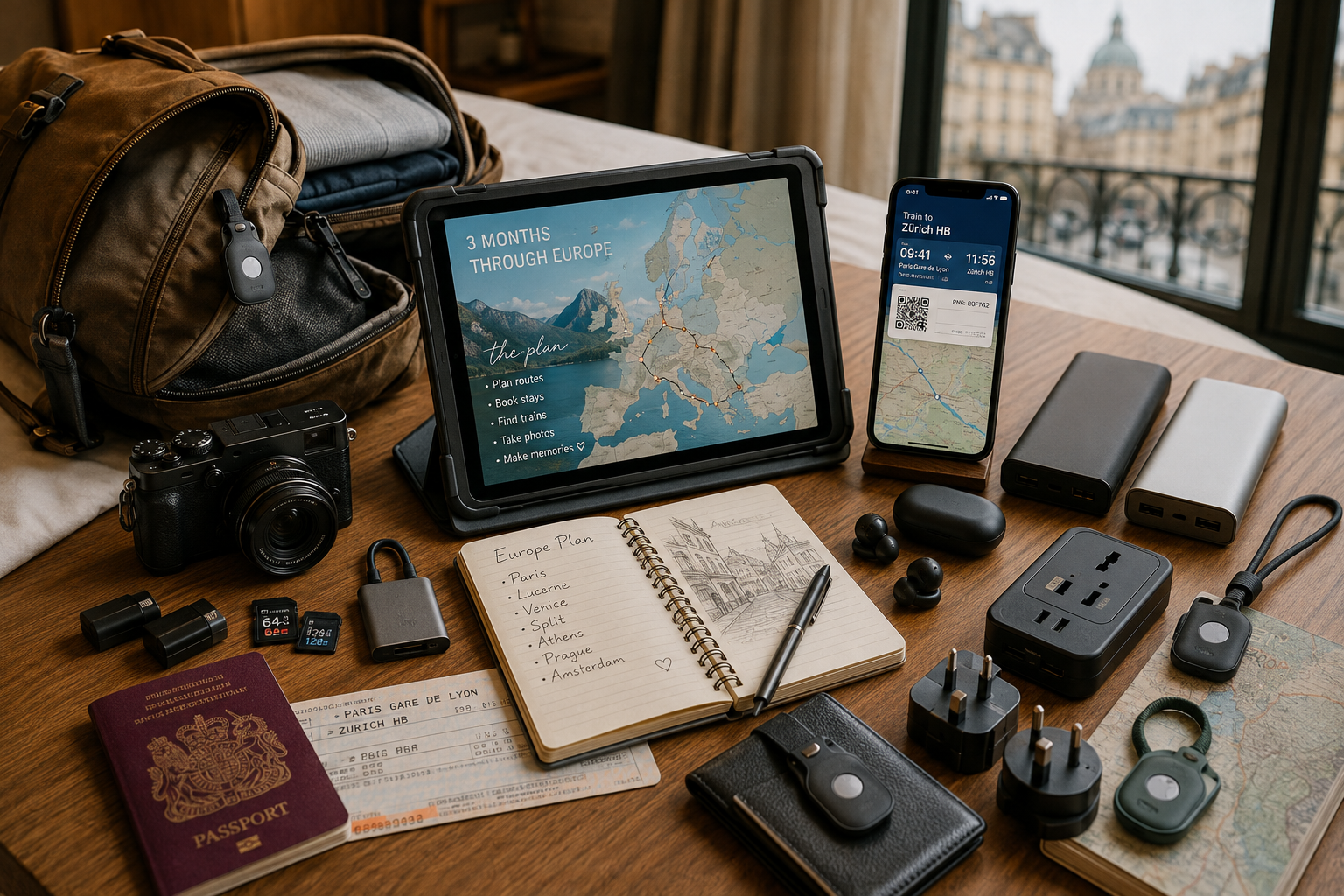
The Technology I Used During Three Months of Traveling Europe
The travel tech that helped me navigate, stay connected, protect my photos, and travel independently.
When I packed for three months of traveling through Europe, I knew I wanted to keep my technology relatively simple.
I wasn't interested in carrying my laptop across multiple countries, and I didn't want my backpack filled with expensive electronics I would constantly worry about. At the same time, I was traveling independently, which meant my phone and a handful of other devices would be working hard.
Technology ended up playing a much bigger role in my trip than I expected.
I used it to navigate unfamiliar cities, pull up train tickets, research gluten-free restaurants, keep track of reservations, photograph places I wanted to remember, back up thousands of photos, communicate with family, and make long travel days a little more comfortable.
After three months on the road, these are the technology tools and accessories I was genuinely glad I brought.
—-------------------------
Some links in this post are affiliate links. If you buy something through them, I may earn a small commission, but it won’t cost you anything extra. I only recommend products I actually used or found helpful during my travels. You can read my full disclosure policy for more details.
—-------------------------
A Tablet Instead of a Laptop
One of the easiest packing decisions I made was leaving my laptop at home. I considered bringing it because three months felt like a long time to be without a computer, but ultimately I didn't want the extra weight or the responsibility of carrying an expensive laptop from city to city.
Instead, I bought a Samsung Galaxy Tab A9+.
I mostly used it for downtime. After a long day of exploring, I sometimes just wanted to get into bed and watch a show or movie. The tablet gave me a larger screen than my phone without taking up much space in my backpack.
I also paired it with a rugged tablet case with a built-in stand. The case protected it from all the inevitable bumps that came with repeatedly packing and unpacking my backpack, and the stand was especially useful when I wanted to prop it up on a bed or pillow at night.
For this particular trip, I never regretted leaving my laptop behind.
The Camera That Took Most of My Europe Photos
A camera was one piece of technology I spent a lot of time thinking about before I left. I wanted better photo quality and more flexibility than I could get from my phone, particularly for landscapes, nature, architecture, and evening photography. But I absolutely did not want to spend three months carrying a large camera body and interchangeable lenses.
The Sony RX100 VII Camera turned out to be a great compromise.
It’s small enough to fit in a crossbody bag or daypack, but it still offers a versatile 24–200mm zoom range. I could take photos of wide city views, close-up architectural details, and landscapes without needing to swap lenses. It also performed well in situations where my phone struggled, particularly when I wanted more control over zoom or was shooting in lower light.
Many of the photos you see throughout Fork & Footpath were taken with this camera.
The Sony RX100 VII Camerakit I purchased also included several accessories I would have needed anyway, such as extra batteries, a charger, and a memory card. Having multiple batteries was especially important because there were plenty of days when I left my accommodation in the morning and didn't return until late at night.
Protecting and Storing My Photos
Because the camera traveled with me almost everywhere, I added a Sony RX100 Screen Protector before leaving. It was a very small expense for something that gave me a lot more confidence tossing the camera into a bag alongside zippers, chargers, and everything else I accumulated during the day.
For storage, I carried SanDisk 128GB Extreme PRO Memory Cards. Three months produce a lot of photos. The 128GB cards gave me enough room that I wasn't constantly deleting images or worrying about storage, and they were fast enough that I never found myself waiting for the camera to finish saving photos before I could take the next one.
How I Backed Up Photos Without a Laptop
The Anker SD Card Reader, 2-in-1 USB-C Memory Card Reader became one of the most useful pieces of technology I packed. Since I wasn't traveling with a laptop, I needed another way to get photos off my camera.
The Anker card reader plugged directly into my phone and allowed me to transfer photos from the camera's SD card. From there, I could upload them to cloud storage instead of relying entirely on the physical memory card.
Losing a camera would have been frustrating, but losing months of irreplaceable travel photos would have been much worse.
It also made it easy to transfer higher-quality photos from my camera to my phone when I wanted to share something from that day's travels on social media. For something that took up almost no space in my bag, it solved a surprisingly big problem.
AirTags Gave Me More Peace of Mind Than I Expected
Before leaving, I bought a multipack of Apple AirTags: one in my daypack, one in my crossbody bag, one in my travel-day backpack, and one in my large Gregory backpack.
Most of the time, I never needed them, but being able to quickly confirm that my luggage was traveling with me gave me enormous peace of mind.
They proved particularly useful when one of my bags was delayed on the trip from Dublin to London. Instead of having absolutely no idea where it was, I had another way to see where the bag appeared to be.
There was another benefit I hadn't initially thought much about: my family could also follow my progress as I traveled. When you're moving around Europe independently for months, that little bit of visibility can be reassuring for everyone back home.
I also used an AirTag Wallet Holder, which is shaped more like a credit card and lets me keep an AirTag in my wallet without creating an awkward lump.
The Budget Earbuds I Brought Instead of My AirPods
I deliberately left my more expensive Apple AirPods at home. Between constantly changing hotels, taking trains, walking around cities, and pulling things in and out of bags, I didn't want one more expensive item to worry about losing.
Instead, I bought a pair of Soundcore Wireless Earbuds. I wore them during long train journeys, while listening to walking tours, and sometimes simply when I wanted music on my travels.
They had excellent battery life, sounded good, and were inexpensive enough that losing one wouldn't have felt like a minor financial crisis.
The One Thing I Never Wanted to Run Out Of: Phone Battery
My phone may have worked harder during those three months than I did. On a normal travel day, I could be using it for Google Maps, train schedules, digital tickets, restaurant research, translation, photography, messaging, hotel information, and reservation confirmations.
That can drain a battery surprisingly quickly, and when you're in an unfamiliar city, a dead phone is more than inconvenient. It can mean losing access to your directions, your train ticket, or the address of where you're staying.
I carried two Anker Power Banks in my daypack almost every day. That might have been overkill for shorter days, but on 12- or 14-hour travel days, I was very happy to have them.
They charged quickly, so I never had to worry about saving my phone battery or choosing between taking another photo and having enough power for Google Maps later.
A good portable charger is one of the few pieces of travel technology I would consider essential rather than simply convenient.
Solving the European Hotel Outlet Problem
I learned very quickly that having the correct plug adapter does not necessarily mean you'll have enough places to plug things in. Some hotel rooms and older apartments had plenty of outlets. Others seemed to have approximately one, usually located somewhere incredibly inconvenient.
By the end of the day, I might need to charge my phone, tablet, camera batteries, smartwatch, earbuds, and power banks. Instead of bringing an adapter for every single device, I brought a compact Travel Power Strip. I could plug the strip into the appropriate European adapter and charge several devices from one outlet.
It might seem like a small detail, but when you’re moving around a lot and need to charge several devices each night, it really made things easier.
Europe Doesn't Use Just One Type of Plug
Before my trip, I knew I would need European power adapters. What I hadn't fully appreciated was that there isn't one universal European outlet. The adapters I needed depended on where I was traveling.
Switzerland Adapter: Switzerland uses Type J outlets, which are different from the standard two-prong outlets you'll encounter in many other European countries. Because of the recessed shape of some Swiss outlets, a generic European adapter isn't always the best solution. Having a Switzerland-specific adapter meant I didn't have to discover that after arriving.
Italy Adapter: Italy was another country where I brought a dedicated adapter. Many accommodations can accept common European plugs, particularly newer or renovated properties, but Italy also uses Type L outlets with three pins arranged in a straight line. Because I was staying in a mix of hotels, apartments, and older buildings, I preferred knowing I had the right adapter rather than hoping every accommodation had been updated.
European & UK Travel Plug Adapter Kit: For most of the rest of the trip, I carried a broader adapter kit that covered the common European plugs as well as the UK. That was particularly helpful because my itinerary involved travel between countries with different outlet standards, including England, France, and Germany. Before traveling through multiple countries, I recommend checking the plug type for each country on your itinerary rather than assuming a single "Europe adapter" will cover the entire trip.
And remember: a plug adapter changes the shape of the plug. It does not necessarily convert voltage, so always check that the electronics you're bringing are compatible with the local voltage.
The Technology I Would Pack Again
After three months in Europe, the thing that surprised me most wasn't how much technology I brought. It was how much I depended on a relatively small collection of it.
My phone took care of most of the practical stuff. My camera captured the memories. Power banks kept everything running. AirTags gave me some extra peace of mind. And my tablet and earbuds made long train rides, flights, and quiet evenings in my room more comfortable.
None of these things made the trip memorable on their own, but they removed small points of friction that could have made independent travel considerably more stressful.
If I were packing for another three-month trip through Europe tomorrow, all of them would go straight back into my bag.
Explore My Travel Guides
-
![Bridge in London England]()
London England
Historic. Diverse. Dynamic.
-
![Street food vendor Paris France]()
Paris France
Romantic. Elegant. Timeless.
-
![Bikes in Amsterdam Netherlands]()
Amsterdam Netherlands
Charming. Laid-back. Scenic.
-
![Bridge view from Bruges Belgium]()
Bruges Belgium
Storybook. Serene. Preserved.
-
![Love locks in Cologne Germany]()
Cologne Germany
Historic. Lively. Welcoming.
-
![Erfurt Cathedral in Germany]()
Erfurt Germany
Storybook. Peaceful. Underrated.
-
![Historical castle-like building with spires and towers, surrounded by a cobblestone square and a metal fence, with trees in front and people walking nearby.]()
Dresden Germany
Resilient. Grand. Artistic.
-
![Historic European clock tower with detailed architecture and a large colorful clock face, against a cloudy sky in a city square.]()
Prague Czech Republic
Atmospheric. Historic. Enchanting.
-
![Vienna Travel Guide]()
Vienna Austria
Refined. Cultural. Graceful.